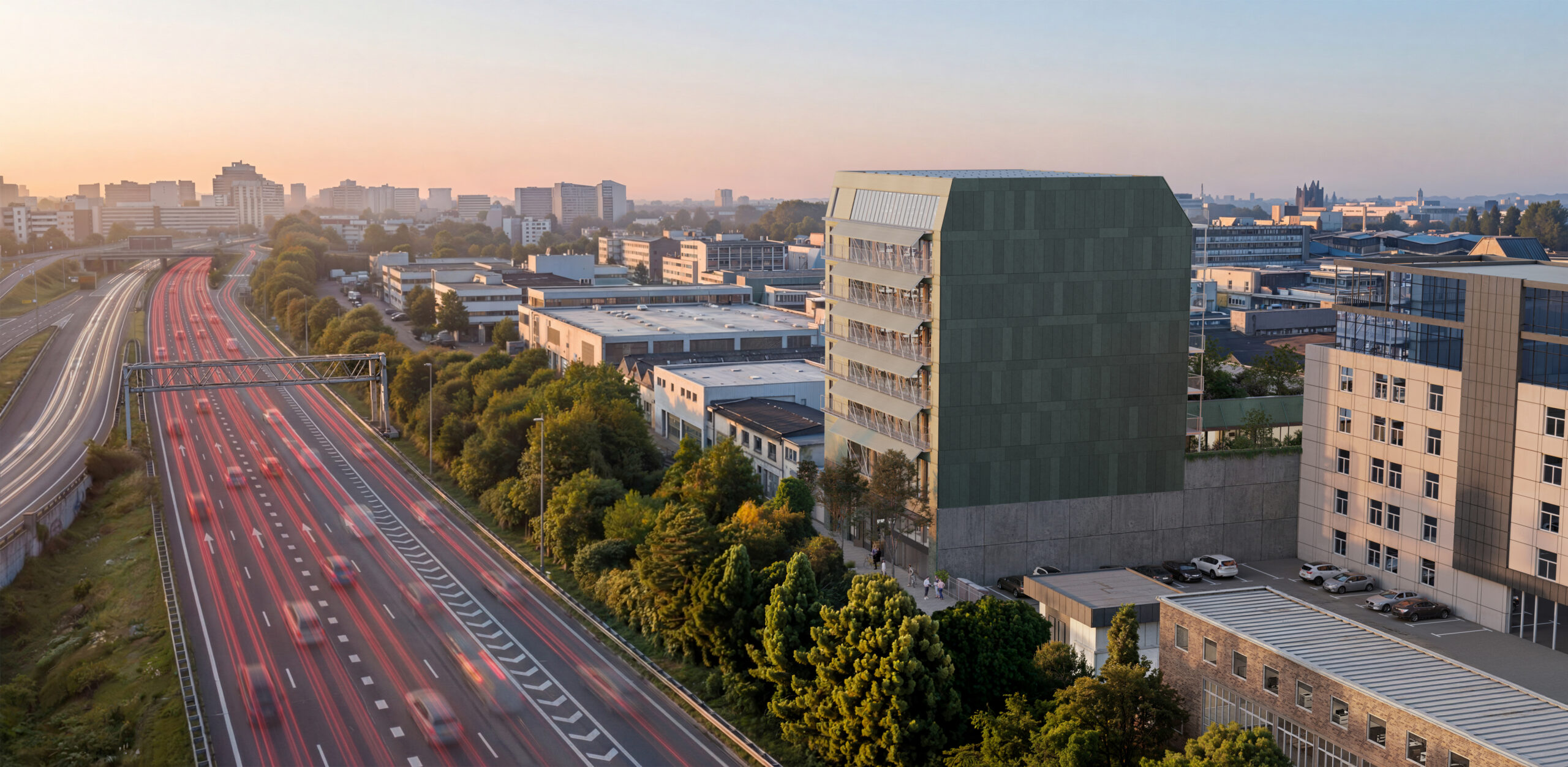
The FIFTY-NINE project at Anthony Fokkerweg 59 concerns the realization of a multifunctional building of approximately 6,300 m² GFA, consisting of a plinth accommodating light industry and parking facilities, with office functions above. The site is part of the Schinkelhaven district, an area that will gradually transform over the coming years from a monofunctional business area into a mixed urban environment, to which residential functions will eventually be added. In this context, the building forms an important link in the transformation towards a robust, future-proof and urban ensemble.
The building volume and programmatic setup are defined within a prescribed building envelope. Characteristic is the fully built footprint at plot level, combined with a plinth of at least 6 meters in height. This generous height provides sufficient flexibility and functional space for local manufacturing industries, logistics and supporting facilities, while contributing to an active and productive streetscape. Above the plinth, the building rises to a maximum height of approximately 33 meters, accommodating office floors with a maximum building depth of 23 meters. These dimensions allow for an efficient office layout with ample daylight penetration and long-term flexibility.
From an urban design perspective, the building forms part of a future perimeter block development. As a result, the architecture presents itself primarily through a clear front and back façade, oriented respectively towards the street and the inner courtyard. The architectural design reinforces this linear urban structure and contributes to the continuity and recognizability of the streetscape. The plinth establishes a strong and active base within the public realm, while the office volumes above are articulated with a lighter and more refined character.
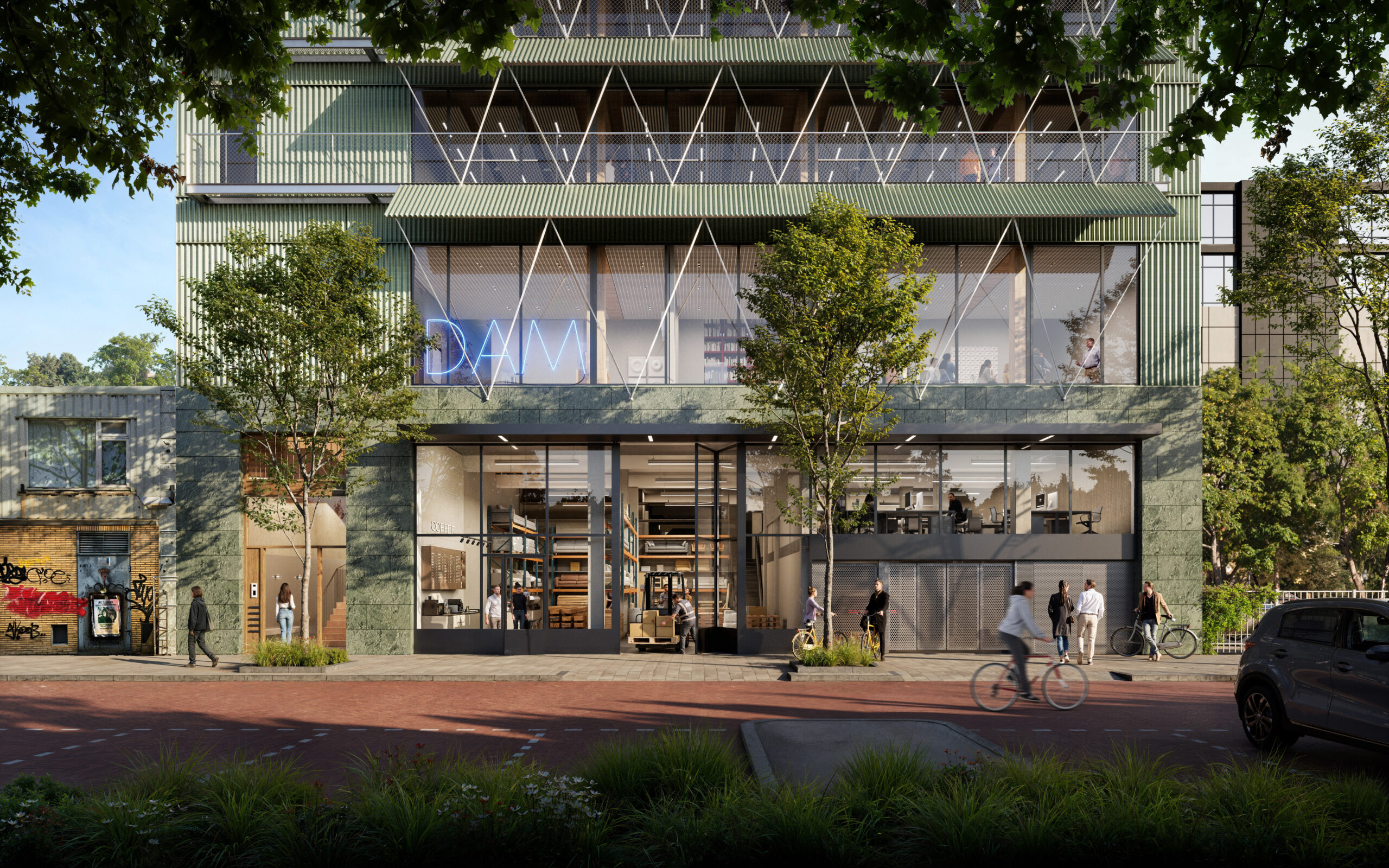
The materialization deliberately expresses the different functions architecturally. The plinth will be executed in green natural stone, conveying a robust appearance that reflects both the manufacturing functions and the industrial character of the surroundings. The façades of the office levels consist of green corrugated aluminium panels for the closed sections, combined with large horizontal glazing bands that provide transparency, daylight access and visual connections. This layered composition strengthens the horizontal expression of the building and enhances the legibility of the various functions.
Both the front and rear façades of the office levels are provided with cantilevered balconies. Along the street side, these balconies are relatively shallow and integrated with characteristic corrugated canopies that function as fixed solar shading devices while reinforcing the architectural identity of the façade. On the garden side, the balconies are deeper and offer space for outdoor use, informal meetings and greenery. In this way, a pleasant transition between interior and exterior spaces is created, enhancing the quality of the working environment.
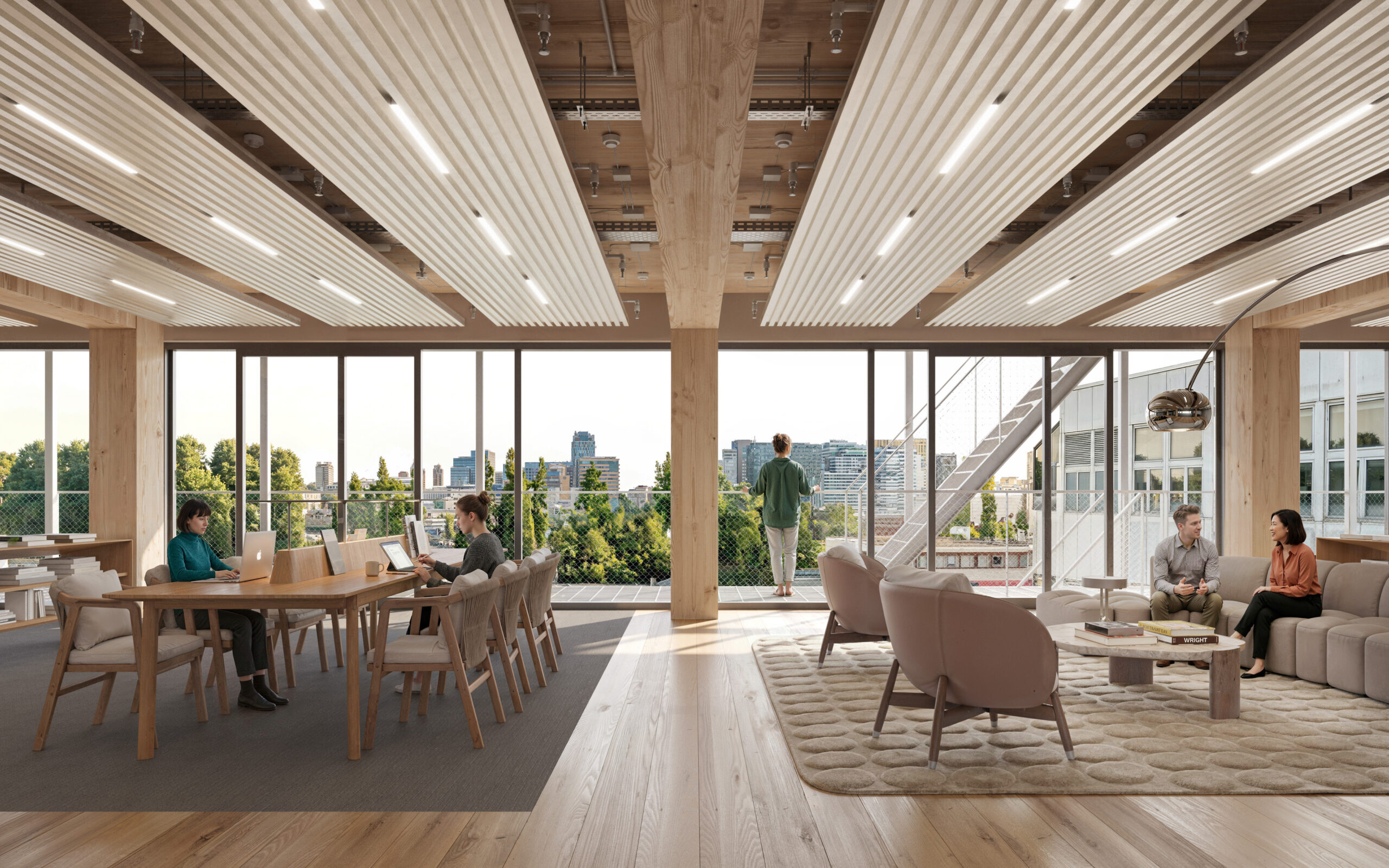
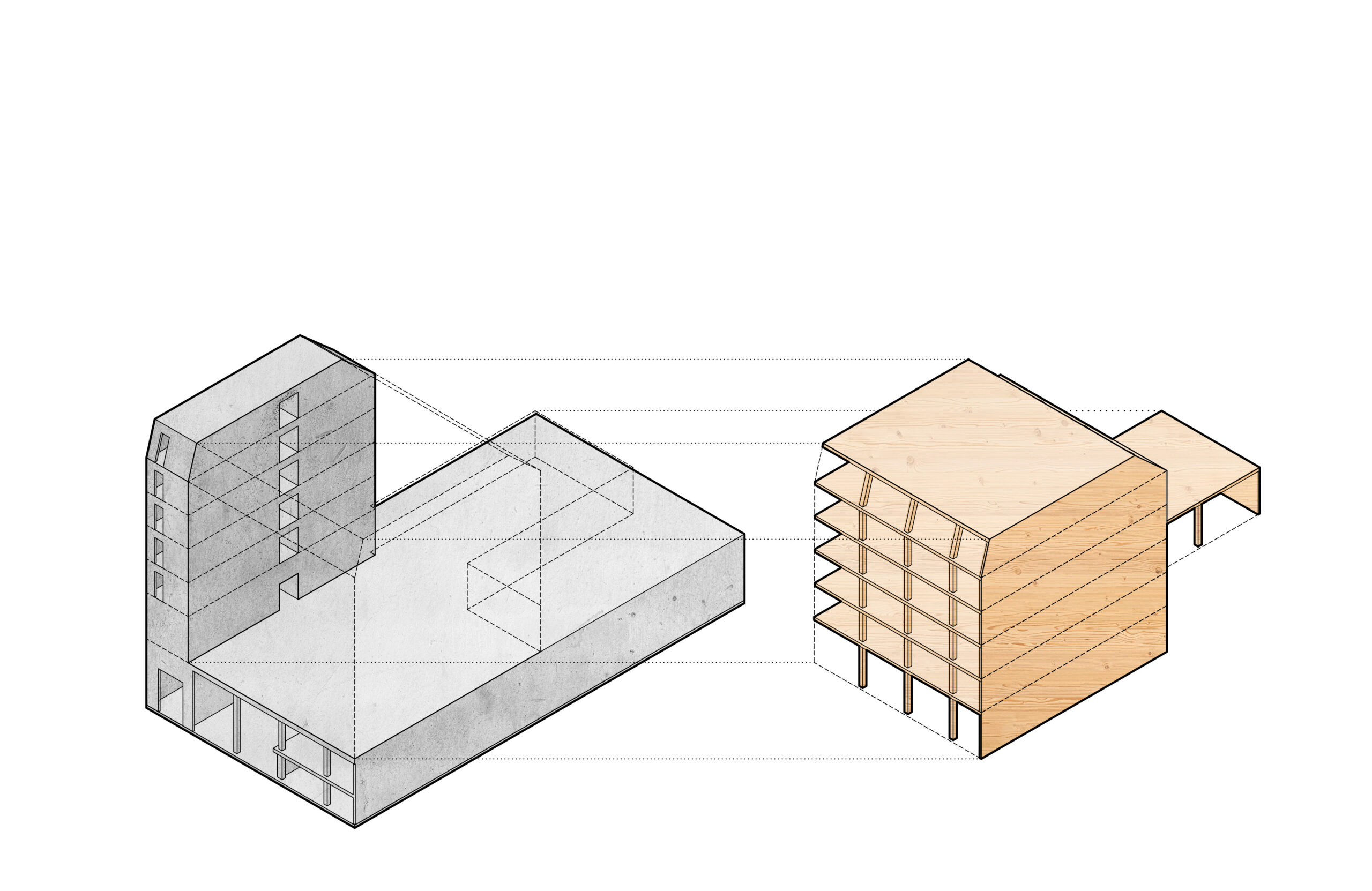
An essential principle within the design is the strategic and sustainable material selection of the structural system. The substructure and the entire circulation core are executed in concrete, ensuring structural stability. The office floors are constructed in timber, with wooden columns, beams and floor systems. This hybrid structure reduces the environmental impact, contributes to a healthy indoor climate and supports the building’s long-term adaptability and circular ambitions.
Generous rooftop gardens will be realized on top of the plinth, with a strong focus on water retention, biodiversity and nature-inclusive design. These green roofs contribute to climate adaptation, reduce urban heat stress and strengthen the ecological quality of the area, while simultaneously providing attractive outdoor spaces for building users.
The project therefore represents a carefully integrated and future-oriented addition to Schinkelhaven, where urban densification, manufacturing industries, high-quality working environments and sustainable ambitions come together within one clear and recognizable building.
We use functional, analytical, and tracking cookies. View our privacy policy here. If you choose to deny, we will only place functional and analytical cookies.
Functional
Altijd actief
The technical storage or access is strictly necessary for the legitimate purpose of enabling the use of a specific service explicitly requested by the subscriber or user, or for the sole purpose of carrying out the transmission of a communication over an electronic communications network.
Preferences
The technical storage or access is necessary for the legitimate purpose of storing preferences that are not requested by the subscriber or user.
Statistics
The technical storage or access that is used exclusively for statistical purposes.The technical storage or access that is used exclusively for anonymous statistical purposes. Without a subpoena, voluntary compliance on the part of your Internet Service Provider, or additional records from a third party, information stored or retrieved for this purpose alone cannot usually be used to identify you.
Marketing
The technical storage or access is required to create user profiles to send advertising, or to track the user on a website or across several websites for similar marketing purposes.